Management reporting , warranties and maintenance

An integrated vision that combines traceability, safety, and performance

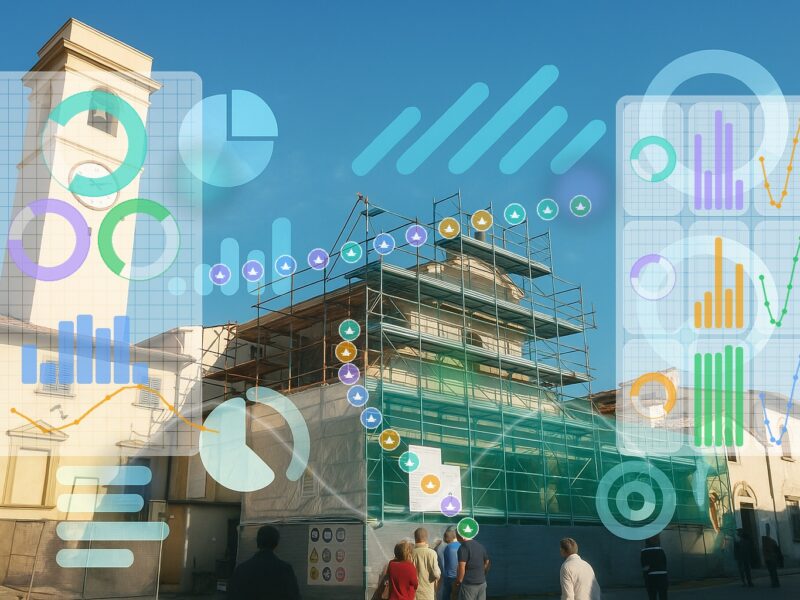
Report management represents a strategic element for the success of construction projects. In a context characterized by high organizational complexity, numerous stakeholders involved, and stringent time, cost, and quality constraints, reports are the main tool for monitoring, documenting, and communicating the progress of the construction site.

Within a model based on the general contractor, reporting is not only descriptive: it becomes a true system of control and governance. Through the collection, analysis, and dissemination of technical, economic, and organizational data, it is possible to support decisions, ensure transparency towards the client, and align suppliers and subcontractors with project objectives. Without a structured reporting system, the risk of errors, inefficiencies, and disputes increases, with direct consequences on quality and completion times.
Main objectives of report management

  1. Monitoring the progress of work (SAL)
    • Accurately document completed activities, those in progress, and those planned.
    • Provide a clear and updated overview of the milestones achieved.
  2. Economic and financial control
    • Compare incurred costs with the initial budget.
    • Highlight deviations and propose corrective actions.
  3. Quality control
    • Record the results of technical checks and intermediate tests.
    • Track any non-conformities and related corrective actions.
  4. Safety management
    • Document the implementation of preventive measures.
    • Report incidents, injuries, or near-misses.
  5. Decision support
    • Provide summary data and comparative analyses to facilitate strategic choices.

Types of reports in the construction field

1. Daily site reports
  • Describe the activities carried out, resources used, weather conditions, and encountered issues.
  • Provide an aggregated view of completed activities compared to the schedule.
  • Include progress charts and KPI indicators.
  • Detail incurred costs, spending forecasts, and cash flow.
  • Integrate data from work accounting and progress states.
  • Document outcomes of technical checks and safety inspections.
  • Include lists of non-conformities and corrective actions.
  • Extract real-time data from information models.
  • Allow simulations and comparisons between planned and actual outcomes.

Report management methodologies

1. Standardization of formats
  • Use predefined templates to ensure data uniformity and comparability.
  • Structure reports in standard sections (activities, costs, quality, safety).
  • Collaborative and cloud platforms for drafting and sharing reports.
  • Automate data collection through IoT sensors and monitoring systems.
  • Percentage progress of works.
  • Cost Performance Index (CPI) and Schedule Performance Index (SPI).
  • Number of non-conformities and recorded incidents.
  • Digital dashboards updated in real-time.
  • Charts and visualizations that facilitate the reading of complex data.

Supporting technologies

  • BIM 4D/5D: temporal and economic integration to extract dynamic reports.
  • Common Data Environment (CDE): a single environment for storing and distributing reports.
  • Project management software: Primavera P6, MS Project, Synchro.
  • Business Intelligence (BI): tools like Power BI or Tableau for advanced analysis.
  • Drones and laser scanners: collecting progress data directly from the site.

Benefits of report management

  1. Transparency
    • Clear sharing of information with all stakeholders.
  2. Efficiency
    • Reduction in decision-making times thanks to reliable and timely data.
  3. Economic control
    • Greater adherence to the budget and reduction of deviations.
  4. Quality and safety
    • Greater traceability of technical checks and preventive measures.
  5. Sustainability
    • Advanced reporting allows monitoring of environmental and energy indicators as well.

Challenges and issues

  • Information overload: risk of overloading reports with non-essential data.
  • Data accuracy: need to ensure the quality of collected information.
  • Cultural resistance: difficulty in adopting advanced digital systems by some operators.
  • Integration of sources: complexity in combining technical, economic, and safety data into a single system.

Integration with the construction cycle

Reporting accompanies the entire project cycle:
  • Design: preparation of monitoring systems and definition of KPIs.
  • Execution: daily data collection and constant report updating.
  • Testing: final documentation of executed activities and achieved performances.
  • Post-construction management: use of reports for maintenance and facility management.

Report management in construction is an essential project governance tool. It does not just record progress but becomes an integral part of the control system, improving transparency, quality, and safety of the construction process.

In a general contractor approach, reporting allows complex data to be transformed into strategic information, reducing risks and promoting timely and informed decisions. Investing in digital tools and structured methodologies for report management means building not only buildings but also efficient, traceable, and sustainable processes.

Segui i nostri profili social
Privacy Overview

This website uses cookies so that we can provide you with the best user experience possible. Cookie information is stored in your browser and performs functions such as recognising you when you return to our website and helping our team to understand which sections of the website you find most interesting and useful.