Cost control

Economic precision as a guarantee of quality and reliability

Cost control represents one of the most strategic activities in managing a construction project. In a sector characterized by often narrow margins and significant market variability, the ability to monitor, forecast, and optimize the economic performance of the project is a crucial factor for overall success.

Within an organizational model based on the general contractor, cost control becomes essential: the single point of contact is responsible for ensuring that all construction phases are carried out within the approved budget, preventing overruns and promptly identifying any deviations. It is not just about recording expenses, but proactively managing financial flows, correlating timelines, resources, and execution quality.
Main objectives of cost control

  1. Prevention of extra costs
    • Anticipate and mitigate economic variations resulting from delays, changes, or operational inefficiencies.
  2. Optimization of financial resources
    • Ensure that every expense aligns with the project’s priorities and milestones.
  3. Budget compliance
    • Ensure that the project adheres to the financial framework approved by the client.
  4. Decision support
    • Provide updated data for strategic decisions during the project.
  5. Transparency and traceability
    • Clearly document financial flows, reducing the risk of disputes.

Tools and methodologies for control

1. Work Breakdown Structure (WBS)
  • Breakdown of the project into work packages, each with an assigned budget.
  • Cost monitoring for specific activities.
  • Integrated analysis of timelines, costs, and work progress.
  • Key indicators:
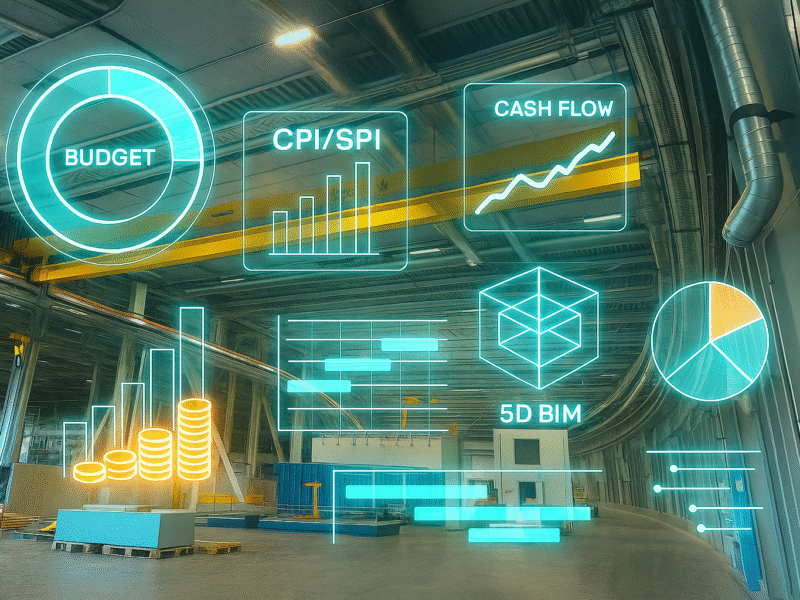
    • CPI (Cost Performance Index): efficiency of budget utilization.
    • SPI (Schedule Performance Index): correlation between timelines and costs.
  • Comparison between planned costs, incurred costs, and the value of completed activities.
  • Identification of causes of deviation (inefficiencies, unforeseen events, changes).
  • Management of cash flows to ensure financial availability at every stage.
  • Coordination between work progress states (SAL) and payments.
  • Digital models that integrate costs, timelines, and quantities.
  • Simulations of economic scenarios based on project changes.

Operational activities of cost control

1. Definition of the initial budget
  • Analytical cost estimation based on metric calculations, price lists, and market analysis.
  • Inclusion of funds for unforeseen events and changes.
  • Division of the budget in relation to structures, systems, finishes, and accessory works.
  • Linking expense items to timeline milestones.
  • Periodic collection of financial data from executing companies.
  • Real-time update of the control system.
  • Preliminary assessment of the economic impact of project changes.
  • Negotiation of additional costs with suppliers and subcontractors.
  • Preparation of financial reports for the client with KPI indicators.
  • Transparent communication of risks and corrective actions.

Support technologies

  • Project management software: MS Project, Primavera P6, Synchro.
  • Work accounting platforms: systems integrated with BIM models.
  • Common Data Environment (CDE): collaborative environments for sharing economic and technical data.
  • IoT systems: monitoring of material and energy consumption, impacting costs.
  • Digital Twin: dynamic assessment of economic performance during construction.

Benefits of effective cost control

  1. Financial stability
    • Reduction of the risk of budget overruns.
    • Increased project reliability in the eyes of investors.
  2. Operational efficiency
    • Resources allocated in a targeted and optimized manner.
    • Elimination of waste and redundancies.
  3. Quality of construction
    • Cost control ensures the availability of funds for quality materials and techniques.
  4. Contractual security
    • Clear and verifiable documentation reduces the risk of disputes with suppliers and subcontractors.
  5. Sustainability
    • Better economic planning promotes the adoption of more efficient technological and environmental solutions.

Challenges and issues

  • Market price variability: fluctuations in raw materials and energy.
  • Supply chain complexity: numerous suppliers and subcontractors to monitor.
  • Technical unforeseen events: geotechnical, weather, or logistics issues.
  • Cultural resistance: difficulties in adopting advanced digital tools.

Integration with the construction cycle

Cost control is present in all operational phases:
  • Detailed design: detailed estimation and budget definition.
  • Construction: periodic monitoring and management of changes.
  • Testing: verification of consistency between incurred costs and the value of the work.
  • Post-construction management: data collected used to optimize future projects and maintenance.

Cost control in construction is not a simple accounting activity, but a strategic process that integrates timelines, resources, and quality. Within a general contractor approach, economic monitoring becomes a central function: only through methodical and continuous control is it possible to transform the complexity of the construction site into an orderly and sustainable process.

Investing in tools, skills, and cost control methodologies means not only adhering to the budget but ensuring the economic and technical success of the project, while simultaneously strengthening client trust and market competitiveness.

Segui i nostri profili social
Privacy Overview

This website uses cookies so that we can provide you with the best user experience possible. Cookie information is stored in your browser and performs functions such as recognising you when you return to our website and helping our team to understand which sections of the website you find most interesting and useful.