Project reports and technical manuals

Technical expertise conveyed with method, precision, and clarity

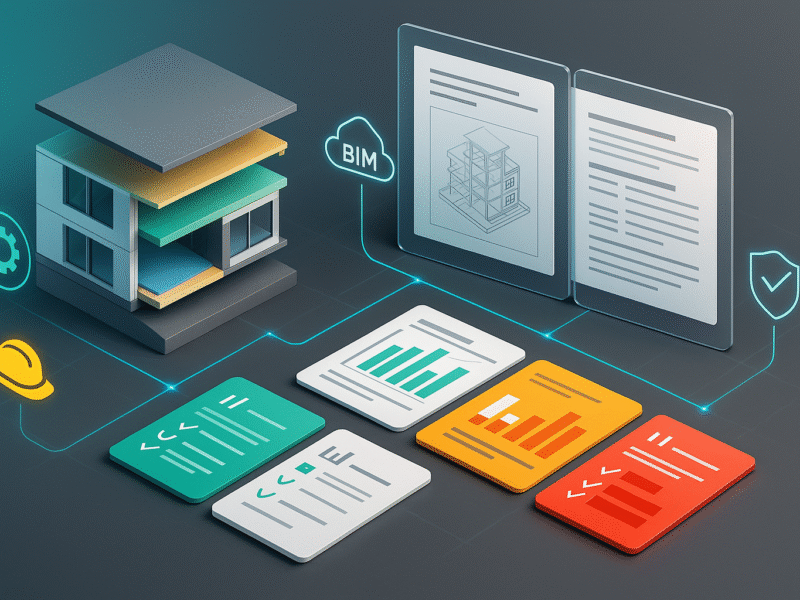
In the construction sector, characterized by increasing project complexity and a more multidisciplinary approach, project reports and technical manuals play a central role in ensuring clarity, traceability, and consistency across the different phases of the construction process. These are not merely descriptive documents, but operational tools that allow for the unambiguous communication of technical information, performance specifications, construction methodologies, and management procedures for the work.

In the context of detailed executive design, the drafting of reports and manuals is essential: on one hand, it allows for the documentation and validation of design choices, and on the other, it provides a practical guide for construction, testing, maintenance, and use of the building. A project lacking complete and structured documentation risks generating ambiguities, execution errors, and difficulties in future management.
Characteristics of project reports

  1. Completeness
    • They must include technical analyses, structural and plant calculations, energy and acoustic assessments.
    • They report the results of simulations and regulatory verifications.
  2. Clarity and readability
    • Precise technical language, accompanied by tables, graphs, and summary sheets.
    • Organization into chapters and sections to facilitate consultation.
  3. Traceability
    • Every piece of data must be referable to a source, a digital model, or a design document.
    • Document versioning to manage revisions.
  4. Multidisciplinary integration
    • Synthesis of contributions from architects, structural engineers, plant engineers, and environmental consultants.
    • Alignment with the BIM model and the Common Data Environment (CDE).

Typical structure of a project report

  • Introduction: objectives, scope, and design criteria.
  • Methodologies: description of the calculation, simulation, and modeling techniques adopted.
  • Analysis and results: energy, acoustic, static, and plant performance.
  • Regulatory compliance: references to laws, regulations, and technical standards (UNI, EN, ISO).
  • Conclusions and recommendations: summary of the choices made and indications for subsequent phases.
  • Appendices: technical sheets, input data, calculation tables.

Functions of technical manuals

1. User and maintenance manual
  • Indicates management methods for systems, preventive and corrective maintenance cycles.
  • Provides instructions to ensure consistent performance throughout the building’s lifecycle.
  • Provides operational guidelines for the installation of structural, plant, and architectural components.
  • Includes assembly diagrams, operational sequences, and safety requirements.
  • Documents the characteristics of materials and equipment.
  • Contains certifications, quality marks, and test data.

Integration with digital tools

  • BIM: reports can be generated directly from information models, with automatic extraction of technical data and metric calculations.
  • Document databases: archiving and consultation of technical manuals through digital platforms.
  • QR code and IoT: linking installed physical components and digital manuals for smart maintenance.
  • Digital Twin: virtual replica of the building that integrates manuals and operational data in real-time.

Benefits of project reports and technical manuals

1. Error reduction
  • Clear and coded information avoids interpretative ambiguities.
  • Structured documentation allows for precise verifications during construction and testing.
  • Technical manuals facilitate installations and maintenance, reducing time and costs.
  • Detailed reports demonstrate compliance with legal and regulatory requirements.
  • Better building management throughout its lifecycle reduces environmental impacts and consumption.

Challenges and issues

  • Standardization: need for uniform guidelines for document drafting.
  • Continuous updating: manuals must be constantly updated based on design or regulatory changes.
  • Management of complex data: large amounts of information to be organized clearly and coherently.
  • Accessibility: ensuring that reports and manuals are accessible to all stakeholders, with different levels of detail.

Integration with the construction cycle

Project reports and technical manuals accompany the entire lifecycle of the work:
  • Design: collection and systematization of technical analyses.
  • Construction: support for installations, checks, and verifications.
  • Testing: comparison between expected results and actual performance.
  • Management and maintenance: operational guide for facility managers and maintenance technicians.
  • Decommissioning: support for the evaluation of reuse or disposal of materials.

Project reports and technical manuals are essential tools in detailed executive design. They are not mere accessory documents, but an integral part of the construction process: the former ensures traceability and validation of design choices, while the latter provides operational guidelines for installation, use, and maintenance.

From a modern perspective, based on digitalization and sustainability, the quality of technical documentation is directly proportional to the quality of the built environment and its ability to maintain performance over time. Investing in the accurate drafting of reports and manuals therefore means investing in the durability, efficiency, and enhancement of the work.

Segui i nostri profili social
Privacy Overview

This website uses cookies so that we can provide you with the best user experience possible. Cookie information is stored in your browser and performs functions such as recognising you when you return to our website and helping our team to understand which sections of the website you find most interesting and useful.