Cost control

Integrated economic verification process for project sustainability

In the construction sector, characterized by complex projects, high resources, and often tight timelines, cost control is one of the most strategic tools to ensure the economic sustainability and management efficiency of a project. It is not an ancillary activity, but an integrated and continuous process that accompanies all phases of the construction cycle: from preliminary design to testing and subsequent management of the building.

Cost control is not just about monitoring incurred expenses: it involves forecasting, planning, and comparing estimated and actual values, allowing for the anticipation of critical issues, prevention of cost overruns, and optimization of resource use. Its importance grows further in a context where error margins are reduced due to increasing competition, variability in raw material prices, and the need to comply with regulatory and sustainability constraints.
Objectives of cost control

  1. Alignment with the budget
    • Ensure that the project develops within the economic limits established during the planning phase.
  2. Prevention of cost overruns
    • Promptly identify discrepancies between estimates and actuals.
  3. Decision support
    • Provide objective data to designers and clients for informed decisions.
  4. Resource optimization
    • Efficiently manage materials, labor, and technologies.
  5. Transparency and traceability
    • Clearly document economic choices and spending flows.

Phases of cost control

1. Cost planning
  • Definition of the initial budget based on project estimates.
  • Analysis of direct costs (materials, labor, machinery) and indirect costs (overheads, safety, financial charges).
  • Evaluation of possible alternative economic scenarios.
  • Systematic collection of actual spending data.
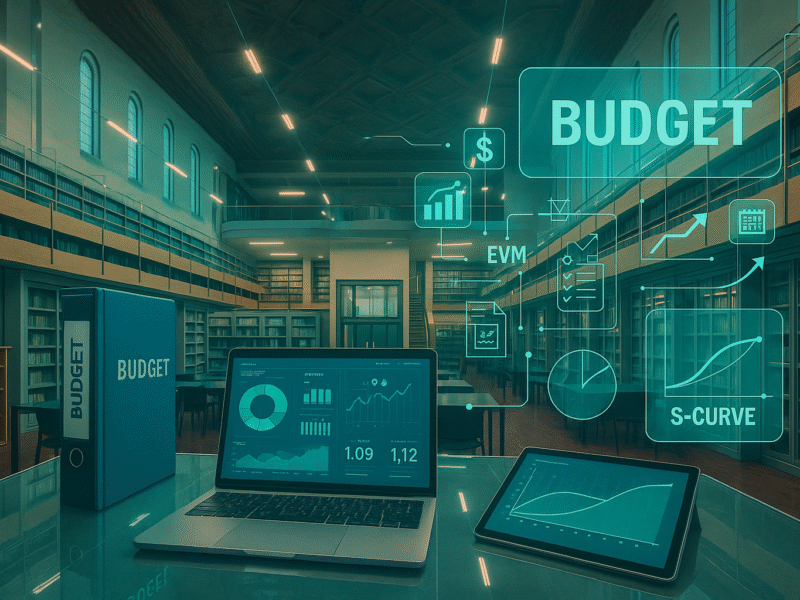
  • Comparison with forecasts using budget and cash flow S-Curve.
  • Use of Earned Value Management (EVM) methodologies to correlate time, costs, and work progress.
  • Identification of causes of any deviations (design errors, site unforeseen events, price variations).
  • Evaluation of impacts on time and quality.
  • Redefinition of activities and resources to stay within economic limits.
  • Revision of the schedule with a view to cost optimization.
  • Preparation of periodic reports for the client and stakeholders.
  • Verification of the final cost of the project against the initial budget.
  • Post-completion analysis to generate useful data for future projects.

Tools and methodologies to support

  1. Project cost control software
    • Digital platforms that integrate economic data with time and resources.
    • Interactive dashboards for real-time monitoring.
  2. BIM 5D
    • Building Information Modeling applied to the economic dimension.
    • Automatic calculation of quantities and cost estimation based on 3D models.
    • Simulations of alternative scenarios based on materials or construction techniques.
  3. Life Cycle Costing (LCC) analysis
    • Beyond construction costs, evaluation of management, maintenance, and disposal costs.
    • Useful approach for high-performance energy and plant buildings.
  4. Lean construction methodologies
    • Reduction of material and labor waste.
    • Collaborative planning to minimize hidden costs and inefficiencies.

Key indicators for cost control

  • Budget at Completion (BAC): total expected cost.
  • Actual Cost (AC): expenses actually incurred.
  • Planned Value (PV): planned value of activities performed at a given time.
  • Earned Value (EV): value of work actually completed.
  • Cost Performance Index (CPI): economic efficiency index.
  • Schedule Performance Index (SPI): schedule compliance index, related to costs.

Benefits of cost control

1. Cost control reduction
  • Ability to anticipate and manage situations that could compromise profitability.
  • Optimization of procurement processes and resource management.
  • Targeted investment in high-performance materials and technologies, reducing future maintenance costs.
  • Traceability of economic flows that strengthens the relationship with clients, partners, and stakeholders.
  • A project completed on time and within budget increases competitiveness in the real estate market.

Cost control is closely linked to:

  • Work scheduling: every time variation has direct economic impacts.
  • Quality management: defects and non-conformities generate cost overruns.
  • Safety: incidents and organizational shortcomings affect budget and timelines.
  • Environmental sustainability: investments in efficient technologies reduce long-term operational costs.

It represents an essential tool for managing the complexity of construction projects. It is not limited to an accounting check, but represents a strategic process that integrates planning, monitoring, and resource management.

Through established methodologies such as EVM, advanced digital tools like BIM 5D, and innovative approaches like Life Cycle Costing, it is possible to transform cost control into an added value element, capable of ensuring not only compliance with economic limits but also the quality, sustainability, and competitiveness of the project.

Ultimately, cost control in construction is not a passive surveillance activity, but a governance lever to transform projects into efficient, durable works consistent with the objectives of the client and the community.

Segui i nostri profili social
Privacy Overview

This website uses cookies so that we can provide you with the best user experience possible. Cookie information is stored in your browser and performs functions such as recognising you when you return to our website and helping our team to understand which sections of the website you find most interesting and useful.