Environmental technologies and life cycle

Towards intelligent, efficient, and sustainable construction

The construction sector, historically one of the most energy-intensive and environmentally impactful, is now called to undergo a profound transformation to address the challenges of climate change, the scarcity of natural resources, and new sustainability regulations. In this context, environmental technologies play a strategic role: they allow for the reduction of emissions, optimization of resource use, improvement of living comfort, and enhancement of building resilience to extreme weather events.

These are no longer marginal or niche solutions, but essential tools to be integrated into the design, construction, and management processes. The adoption of environmental technologies enables us to rethink construction as an intelligent and interconnected system, capable of ensuring efficiency, quality, and sustainability throughout the entire lifecycle of the project.

Applications of environmental technologies

Environmental technologies find application in various areas of construction, each with a significant impact on the overall sustainability of the built environment.
1. Energy efficiency and envelope management
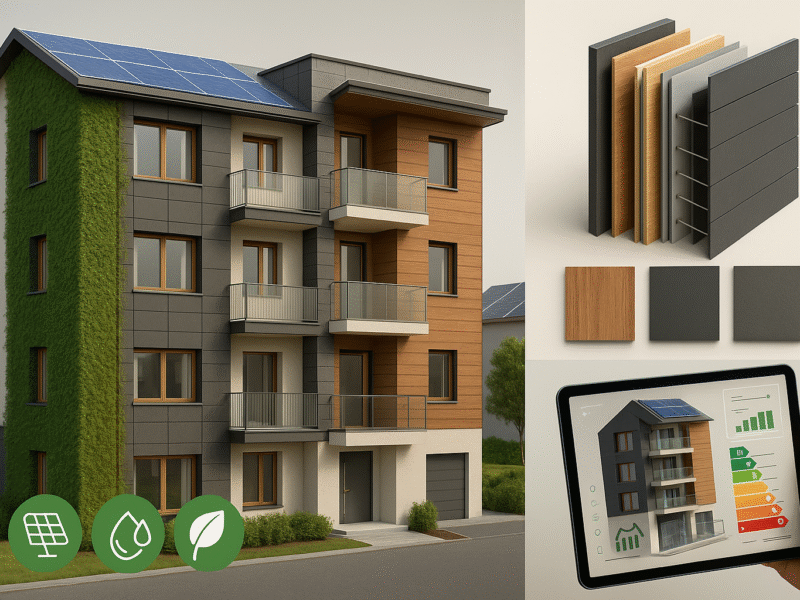
  • Ventilated facades and eco-friendly insulation systems reduce the energy demand for heating and cooling.
  • Electrochromic glass and smart windows allow for automatic regulation of light and thermal transmittance.
  • Green roofs and vegetative walls contribute to microclimate regulation, reduction of urban heat islands, and improvement of air quality.
  • Building-integrated photovoltaics (BIPV): panels that become an integral part of roofs and facades.
  • Solar thermal systems for domestic hot water production and heating support.
  • Low-enthalpy geothermal energy, combined with heat pumps, for efficient climate control.
  • Hybrid systems that integrate multiple renewable sources with storage systems.
  • Dual systems for the recovery and reuse of greywater.
  • Rainwater harvesting systems for non-potable uses.
  • Green roofs and permeable pavements to improve soil permeability and reduce hydrogeological risk.
  • Low-clinker concrete, using industrial by-products such as fly ash or blast furnace slag.
  • Certified structural wood and cross laminated timber (CLT) systems for low-impact buildings.
  • Recycled materials and those from circular economy supply chains.
  • Low-VOC interior finishes, to reduce emissions of volatile organic compounds.
  • Building Management System (BMS): platforms that integrate the management of systems, consumption, and comfort.
  • IoT sensors and artificial intelligence: to monitor environmental parameters and optimize resource use.
  • Digital Twin: virtual simulations that replicate the energy and environmental behavior of buildings in real-time.
  • Advanced home automation: systems that regulate lighting, climate control, and ventilation based on occupancy and environmental conditions.
  • On-site sorting and treatment plants for recycling demolition materials.
  • Modular prefabricated solutions to reduce construction waste and increase the reversibility of structures.
  • Closed-loop materials, designed to be disassembled and reintroduced into the production process.

Methodologies and support tools

Environmental technologies in construction integrate with advanced analysis and evaluation methodologies:

  • Life Cycle Assessment (LCA): measures the environmental impact of materials, technologies, and systems throughout their entire lifecycle.
  • Life Cycle Costing (LCC): evaluates total costs, including management and disposal costs.
  • Environmental Product Declarations (EPD): certifications that provide objective data on the environmental performance of products.
  • Building Information Modeling (BIM 6D): integrates energy and environmental data, enabling simulations and predictive scenarios.

Benefits of adopting environmental technologies

The integration of environmental technologies in the construction sector generates tangible benefits on multiple levels:

1. Environmental

Reduction of greenhouse gas emissions, improvement of air quality, mitigation of heat island effects.

Reduction of operational costs due to energy and water efficiency, increased material longevity, and reduced maintenance expenses.

Improvement of living comfort, health, and safety for occupants.

Enhancement of real estate value and increased market competitiveness.

Compliance with European and national directives on sustainability, efficiency, and resilience.
Environmental technologies today constitute an essential pillar for the construction sector. Their application not only reduces environmental impacts but also improves building performance, generates economic and social value, and ensures resilience to climate challenges.

The future of construction will increasingly be characterized by the integration of sustainable technological solutions, capable of transforming the built environment into an intelligent, circular, and efficient system. Investing in environmental technologies means building not only “greener” buildings and cities but also more resilient, functional, and oriented towards the well-being of people and communities.

Segui i nostri profili social
Privacy Overview

This website uses cookies so that we can provide you with the best user experience possible. Cookie information is stored in your browser and performs functions such as recognising you when you return to our website and helping our team to understand which sections of the website you find most interesting and useful.