Predictive Maintenance

Predict to Prevent: Technologies and Data for a New Paradigm in Building Maintenance

The maintenance of a building is not just a conservation activity but a strategic process to ensure safety, efficiency, and sustainability throughout the entire life cycle of the building. Traditionally, corrective maintenance strategies (intervention after failure) or scheduled preventive maintenance (periodic interventions) have been used. However, these approaches have significant limitations: the former exposes to unforeseen risks and costs, while the latter can lead to resource waste and unnecessary interventions.

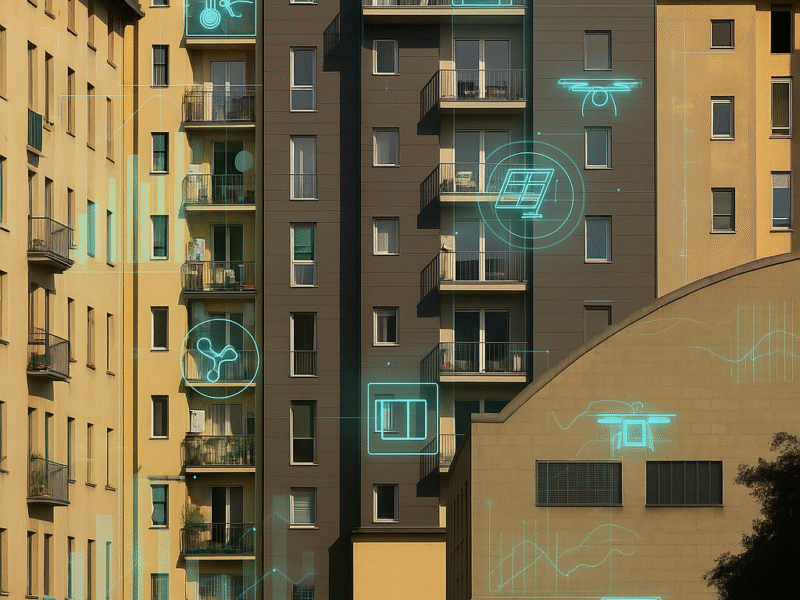
Predictive maintenance, enabled by digital engineering and the integration of emerging technologies such as IoT sensors, artificial intelligence, and digital twins, represents a fundamental evolution today. It allows for the early prediction of failures or degradation, based on continuous analysis of real data, and intervention only when truly necessary. This way, an optimal balance between costs, efficiency, and safety is achieved, while also improving the sustainability of management operations.

Main Features of Predictive Maintenance

  1. Data-driven
    • Decisions are not based on fixed time intervals but on real-time data collection.
    • Sensors installed on plants and structures provide information on vibrations, temperature, humidity, energy consumption, structural loads.
  2. Advanced Data Analysis
    • Application of machine learning algorithms to identify patterns and anomalies.
    • Use of predictive models to estimate the remaining life of critical components.
  3. Digital Integration
    • Connection with BIM platforms and digital twins to visualize the real-time status of the work.
    • Virtual simulations to evaluate failure scenarios and their consequences.
  4. Proactive Approach
    • Targeted and planned interventions only when data indicates a real risk.
    • Optimization of human and material resource management.

Applications in the Building Sector

1. Load-bearing structures
  • Monitoring with sensors for deformations and micro-cracks.
  • Prediction of local failures or material degradation (concrete, steel, wood).
  • Control of energy performance and thermo-hygrometric conditions.
  • Early detection of anomalies in compressors, fans, or distribution systems.
  • Monitoring of loads and temperatures to prevent overloads or short circuits.
  • Predictive analysis of storage batteries and photovoltaic systems.
  • Sensors for detecting hidden leaks.
  • Prediction of scaling or failures in pumps.
  • Continuous monitoring of pressure and sprinkler efficiency.
  • Predictive testing of smoke detection systems.
  • Analysis of material degradation and waterproofing.
  • Detection of energy efficiency of windows.

Supporting technologies

  • IoT Sensors: real-time data collection on structural and plant parameters.
  • Digital Twin: digital twin of the building, updated with real data for predictive simulations.
  • Machine Learning and AI: algorithms that analyze historical and current data to predict failures.
  • Big Data Analytics: management of large volumes of data from sensors and digital platforms.
  • Cloud computing: storage and access to data for distributed and collaborative analysis.

Benefits of Predictive Maintenance

1. Reduction of operational costs
  • Elimination of superfluous interventions typical of preventive maintenance.
  • Limitation of unforeseen costs due to sudden failures.
  • Prevention of failures that could compromise the use of the building or the safety of users.
  • Constant monitoring of performance to optimize consumption.
  • Identification of hidden inefficiencies.
  • Extension of the useful life of structures and systems.
  • Reduction of premature degradation through targeted interventions.
  • Less resource use and reduction of waste from unnecessary maintenance.
  • Better management of the material life cycle.
  • Digital dashboards with real-time updated KPIs.
  • Possibility to develop more effective management strategies based on objective data.

Challenges and Critical Issues

  • Initial Investment: installation of sensors, digital platforms, and AI systems requires high costs.
  • Data Management: need to ensure the quality, security, and privacy of collected information.
  • Specialized Skills: professional figures are needed to interpret complex data and manage digital systems.
  • Interoperability: difficulty in integrating software, existing plants, and new digital systems.

Integration into the Building Life Cycle

Predictive maintenance fits into a broader vision of life cycle management:

  • In the design phase, digital models already integrate useful information for future management.
  • During construction, sensors and digital infrastructures are prepared for monitoring.
  • In the management phase, collected data feeds digital twins and predictive platforms.
  • In the decommissioning phase, historical information allows for more effective reuse and recycling strategies.

Predictive maintenance represents one of the most advanced and strategic applications of digital engineering in construction. Based on a data-driven and proactive approach, it allows for a radical transformation of work management, ensuring greater safety, efficiency, and sustainability.

Thanks to the integration of IoT sensors, artificial intelligence algorithms, and digital twins, buildings become intelligent organisms capable of self-diagnosing and communicating their maintenance needs.

Ultimately, adopting predictive maintenance is not just an opportunity to reduce costs and risks, but a fundamental step towards achieving resilient, digital, and future-oriented construction.

Segui i nostri profili social
Privacy Overview

This website uses cookies so that we can provide you with the best user experience possible. Cookie information is stored in your browser and performs functions such as recognising you when you return to our website and helping our team to understand which sections of the website you find most interesting and useful.