
Architectural and Environmental Acoustics

Designing sound to build well-being and harmony in spaces

Architectural and environmental acoustics represents a fundamental discipline in the contemporary building context, where the quality of spaces is measured not only through aesthetic or functional parameters but also in relation to sound comfort and the acoustic impact on the surrounding environment. Acoustic design is now an integral part of the detailed executive design, as it ensures high performance in terms of usability, well-being, and sustainability of the works.

A building not correctly designed from an acoustic point of view can generate significant issues: discomfort for users, loss of functionality in spaces intended for specific activities (classrooms, theaters, conference rooms), non-compliance with current regulations, and negative impacts on the urban context. Conversely, a methodical and integrated approach to acoustic design contributes to improving quality of life, reducing noise pollution, and enhancing the architectural work as a whole.
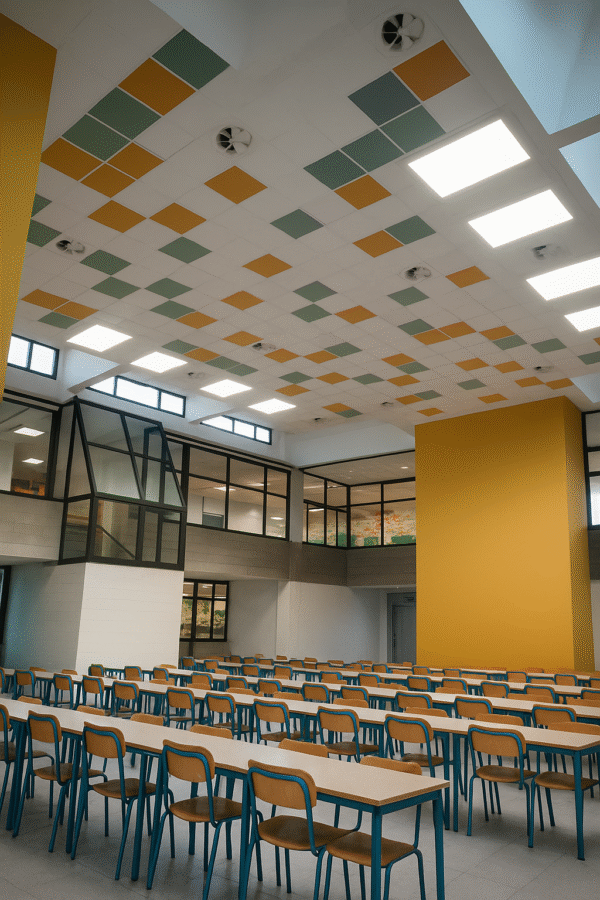
Architectural acoustics: principles and applications

Architectural acoustics focuses on the behavior of sound within built spaces, with particular attention to the following aspects:

  1. Sound insulation
    • The ability of building structures (walls, floors, windows) to reduce noise transmission between adjacent spaces.
    • Reference parameters: sound insulation index (Rw), impact sound insulation index (Ln,w).
  2. Internal acoustic correction
    • Optimization of sound quality within environments through the use of sound-absorbing materials.
    • Main parameters: reverberation time (T30), clarity (C50/C80), definition (D50).
  3. Design of specialized environments
    • Spaces such as theaters, auditoriums, and conference rooms require advanced simulations to ensure uniform sound distribution.
    • Acoustic modeling techniques based on ray tracing or finite wave software.
  4. Interaction with technological systems
    • Control of vibrations and noise generated by HVAC systems, elevators, pumps, and generators.
    • Use of anti-vibration joints, silencers, and dedicated shielding.

Environmental acoustics: principles and applications

Environmental acoustics deals with the propagation of noise outside buildings and the sound impact on the urban context:
  1. Assessment of noise pollution
    • Field measurements according to UNI/ISO standards to characterize sound sources.
    • Analysis of equivalent levels (Leq), maximum peak (Lmax), and differential levels.
  2. Design of acoustic barriers
    • Sound-insulating or sound-absorbing structures to reduce noise diffusion from road and rail infrastructures.
    • Optimization of geometries and materials to maximize efficiency.
  3. Acoustic urban planning
    • Integration of acoustic studies into regulatory plans and urban masterplans.
    • Creation of “acoustic maps” to identify critical areas and define mitigation strategies.
  4. Building-context acoustic compatibility
    • Analysis of background environmental noise to ensure that internal performance meets regulatory limits.
    • Design solutions for high-performance facades and windows.

Tools and operational methodologies

  • Acoustic simulation software: predictive calculation models for internal and external analysis (EASE, Odeon, SoundPLAN, CadnaA).
  • Building Information Modeling (BIM): integration of acoustic parameters into multidisciplinary models.
  • Sound level measurements: use of integrating sound level meters and omnidirectional microphones for on-site verification.
  • Vibro-acoustic analysis: FEM and BEM (Boundary Element Method) techniques for vibration modeling.

Regulatory reference parameters

Acoustic design must comply with specific requirements imposed by national and international regulations:
  • DPCM 5/12/1997 (Italy): passive acoustic requirements of buildings.
  • UNI EN ISO 3382: measurement of acoustic parameters in environments.
  • Directive 2002/49/EC: management of environmental noise and acoustic mapping.
  • LEED and BREEAM guidelines: sustainability certifications that include acoustic parameters.

Benefits of correct acoustic design

  1. Comfort and well-being
    • Improvement of indoor livability.
    • Reduction of acoustic stress for users.
  2. Functionality
    • Guarantee of speech intelligibility and sound quality in specialized environments.
    • Increase in performance in schools, offices, and collective spaces.
  3. Sustainability
    • Contribution to achieving energy-environmental certification objectives.
    • Reduction of sound emissions to the surrounding environment.
  4. Enhancement of the work
    • Increase in property value thanks to certified acoustic performance.
    • Improved building reputation in terms of overall quality.

Challenges and issues

  • Interdisciplinary complexity: need to coordinate architects, structural engineers, and plant designers.
  • Regulatory evolution: constant updates require continuous monitoring.
  • Performance-cost balance: high-performance solutions may have high initial costs.
  • Influence of environmental variables: weather and urban conditions affect actual performance.

Architectural and environmental acoustics is embedded in all project phases:

  • Preliminary design: analysis of acoustic requirements and context evaluation.
  • Detailed executive design: functional schemes, material specifications, and predictive simulations.
  • Construction: quality control of materials and on-site verification.
  • Management and maintenance: monitoring of acoustic parameters and any corrective interventions.

In conclusion, architectural and environmental acoustics is no longer an accessory aspect of design but a central element to ensure quality, sustainability, and regulatory compliance of building works. Thanks to the integration of digital simulations, experimental methodologies, and multidisciplinary approaches, it is possible to create buildings that meet user needs while respecting the surrounding environment.

Investing in accurate acoustic design means building more comfortable, functional, and resilient spaces, in line with the challenges of contemporary society and the expectations of well-being and sustainability that drive the construction of the future.

Privacy Overview

This website uses cookies so that we can provide you with the best user experience possible. Cookie information is stored in your browser and performs functions such as recognising you when you return to our website and helping our team to understand which sections of the website you find most interesting and useful.