Definition of Architectural Design for public and private multifunctional buildings

Integrated spaces for sustainable, flexible, and connected cities

Multifunctional buildings, whether public or private, today represent a strategic building type to meet the complex needs of contemporary society. Spaces capable of hosting different functions—cultural, commercial, residential, managerial, or recreational—become true hubs of aggregation, capable of regenerating urban fabrics and offering a more efficient use of land and resources.

The definition of the architectural project in this context plays a central role: it determines not only the aesthetic identity of the work but also its functionality, flexibility of use, integration with the urban context, and compliance with complex regulations involving multiple disciplines. Therefore, the architectural design of multifunctional buildings requires an integrated and multidimensional approach, capable of reconciling technological innovation, safety, sustainability, and quality of spaces.
Peculiar characteristics of multifunctional buildings

  1. Functional versatility
    • Combination of spaces with different purposes (offices, residences, retail, public services, common areas).
    • Need to integrate flows and functions without generating usage conflicts.
  2. Flexibility and adaptability
    • Modular design allowing reconfigurations over time.
    • Scalable plant systems and easily modifiable space distribution.
  3. Urban integration
    • Dialogue with the surrounding fabric through accessible public spaces, squares, pedestrian paths.
    • Ability to generate positive impacts in terms of livability and neighborhood attractiveness.
  4. Environmental and energy performance
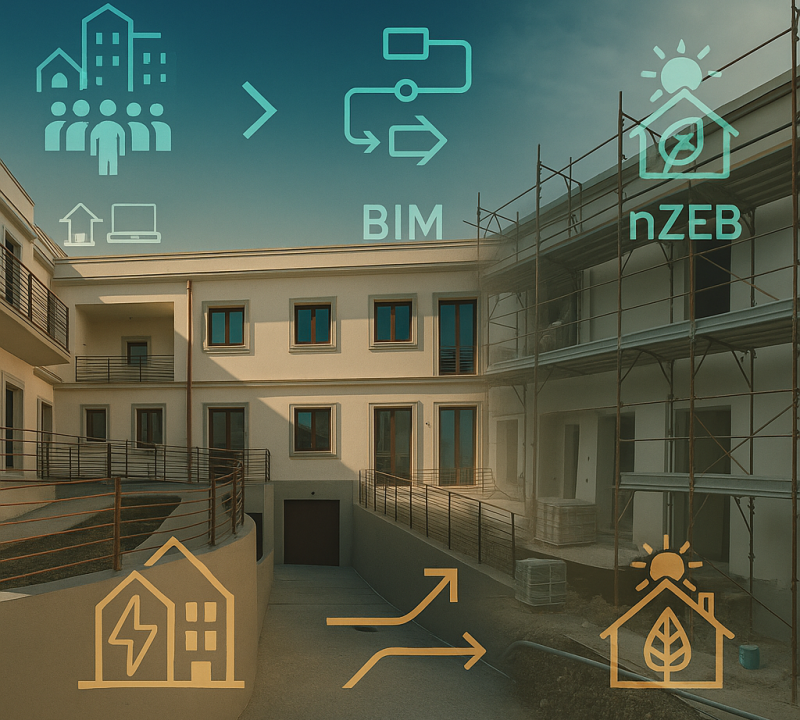
    • Application of nZEB (nearly Zero Energy Building) criteria.
    • Use of renewable sources and passive climate control strategies.

Phases of project definition

1. Preliminary analysis
  • Study of the site, urban constraints, and client requirements.
  • Analysis of mobility flows and vehicular and pedestrian accessibility.
  • Identification of functions to integrate and their relationships.
  • Development of volumetric plans that translate functional needs into spatial solutions.
  • Definition of an architectural language consistent with the building’s identity and urban context.
  • Integration of public and private functions into a unified architectural entity.
  • Coordination between architecture, structural engineering, and plant design.
  • Energy, acoustic, and lighting simulations to verify performance.
  • Design of vertical and horizontal circulation systems (elevators, stairs, corridors) suitable for complex flows.
  • Compliance with urban and building regulations.
  • Conformity to fire safety and seismic requirements.
  • Compliance with universal accessibility standards.
  • Construction details, material specifications, and plant technologies.
  • Coordination of documentation for obtaining permits.
  • Preparation of safety and scheduled maintenance plans.

Tools and methodologies to support

  • Building Information Modeling (BIM): integrated management of architectural, structural, and plant data, with possibilities for 4D and 5D simulations.
  • Digital simulations: dynamic analyses of thermal-hygrometric, acoustic, and lighting comfort.
  • GIS (Geographic Information System): tools to understand the relationship between the building and the urban-territorial context.
  • LCA and LCC: environmental and economic life cycle assessments of design solutions.
  • Rendering and augmented reality: tools to validate concepts and solutions with clients and stakeholders.

Benefits of a correct project definition

  1. Optimal functionality
    • Better management of internal and external flows.
    • Consistency between usage needs and architectural solutions.
  2. Economic efficiency
    • Reduction of changes during construction.
    • Optimization of construction and management costs.
  3. Environmental sustainability
    • Lower consumption of natural resources.
    • Adoption of solutions to reduce emissions and improve resilience.
  4. Attractiveness and real estate value
    • Greater market competitiveness for quality multifunctional buildings.
    • Increase in value over time thanks to flexibility and efficiency.
  5. Social and urban integration
    • Buildings capable of generating public spaces and aggregation opportunities.
    • Improvement of quality of life on an urban scale.
ChatGPT Image 13 ott 2025, 15_27_59

The definition of the architectural project for public and private multifunctional buildings is a complex process that requires a systemic, interdisciplinary, and long-term oriented approach. It concerns not only the aesthetic aspect but above all the building’s ability to integrate different functions, interact with the context, comply with regulatory constraints, and ensure sustainability and resilience.

Through the use of advanced digital tools, life cycle assessment methodologies, and strong coordination between architecture, engineering, and plants, it is possible to create works capable of combining architectural quality, operational efficiency, and social value.

Ultimately, accurate project definition is the essential premise for multifunctional buildings that are not only efficient and safe but also catalysts for innovation, urban development, and collective well-being.

Segui i nostri profili social
Privacy Overview

This website uses cookies so that we can provide you with the best user experience possible. Cookie information is stored in your browser and performs functions such as recognising you when you return to our website and helping our team to understand which sections of the website you find most interesting and useful.